
986-HP Carbon McLaren 720S: My First McLaren Drive Ruined Me
I have driven quick cars, but my first McLaren experience—a 1016 Industries widebody 720S—nearly ruined every other performance car for me. Even in 2026, when hybrid hypercars and silent EVs dominate headlines, this twin-turbo 4.0-liter V8 monster remains a benchmark for what a focused, analog-feeling supercar can be. It is not stock. It is not subtle. And after a day in Malibu with 1016 Industries founder Peter Northrop, I understand why his personal daily driver doubles as a rolling laboratory.
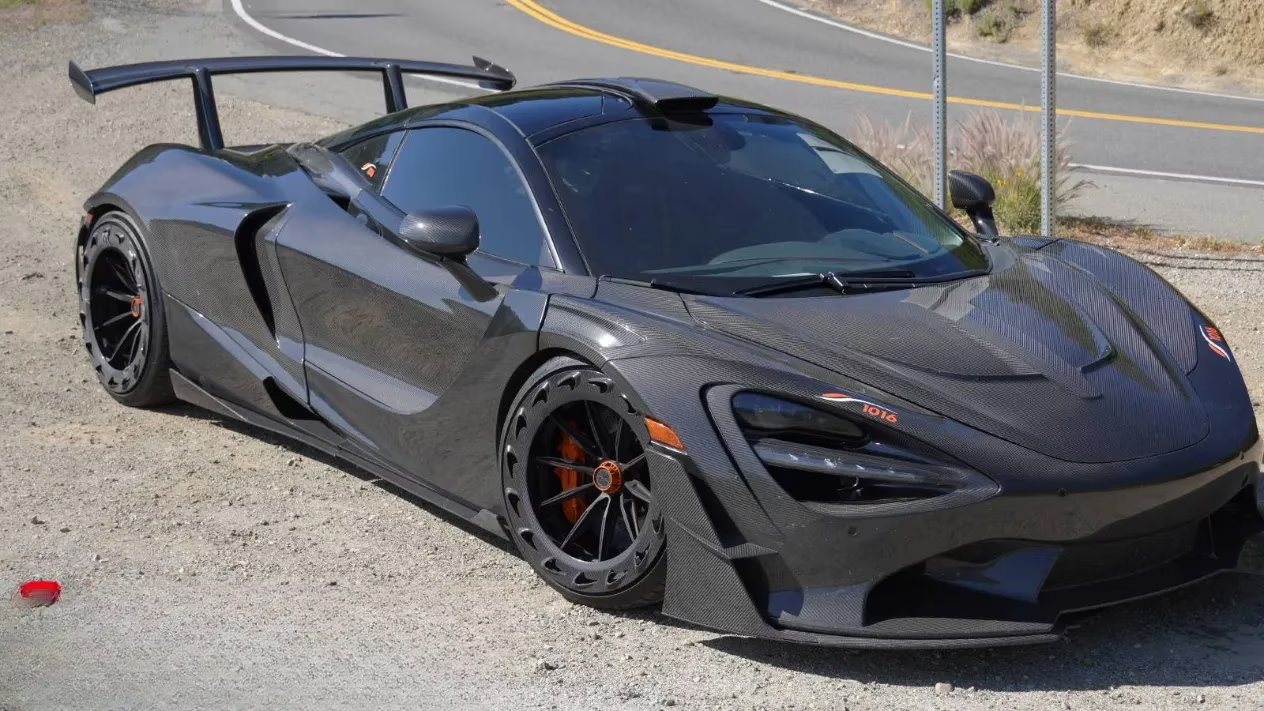
Northrop rolled up next to my Porsche Cayenne at the base of Las Flores Canyon off the Pacific Coast Highway. Compared to the twin-turbo 4.5-liter V8 in the SUV, the McLaren burbled and grumbled as we outlined a filming plan, but never to the point of excess. No neighbors complained. His daily still makes almost anyone stop and stare, because all that exposed carbon demands attention. An elderly man and his grandson even chased us down Hume Road for a closer look. As a cyclist obsessed with lightweight bicycle components, I already love carbon fiber. But I also know the miracle material’s limitations, and Northrop happily discussed them while showing off the car that serves as his personal testbed.
The 1016 Industries Treatment
| Specification | Detail |
|---|---|
| Engine | Twin-turbo 4.0-liter V8 |
| Peak power | 986 whp on dyno |
| Drivetrain | RWD |
| Transmission | 7-speed automatic |
| Weight savings | 420 pounds removed |
| Curb weight | Around 2,800 pounds |
| Aero target | 200+ mph |
All in, the car wears replacement body panels, doors, and a wing that shave 420 pounds off the 720S’s already svelte curb weight of around 3,200 pounds. Each door saves 75 pounds alone. The only remaining piece of McLaren’s original exterior surrounds the knee-height exhaust tips, which Northrop explained cause enough heat to make retaining the factory panel a must. On a carbon-fiber car, you might expect titanium exhaust. Northrop eschewed the more typical lightweight exhaust manufacturing in favor of a more refined rumble.
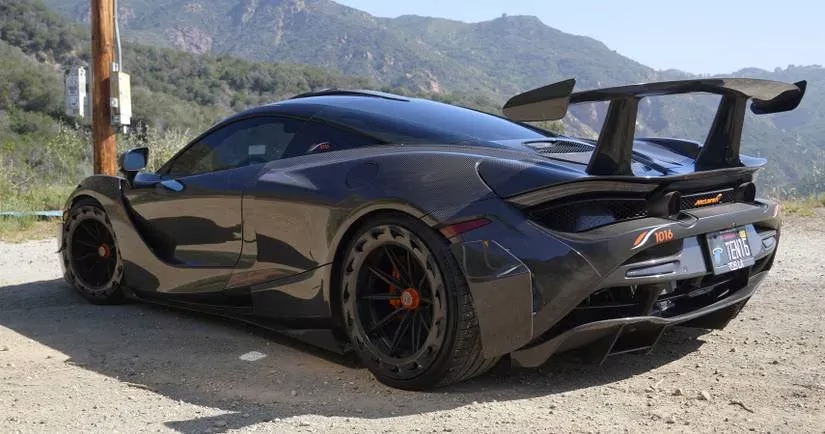
Even with a significantly lighter body, he still worked over the twin-turbo 4.0-liter V8 until a dyno test logged a peak of 986 horsepower—at the wheels. 1016 Industries also revises the suspension to retain McLaren’s famous driving dynamics despite the significant weight savings, while improving unsprung mass with aftermarket wheels shod in Michelin Pilot Sport 4S rubber and, believe it or not, carbon fiber covers complete with McLaren logo cutouts.
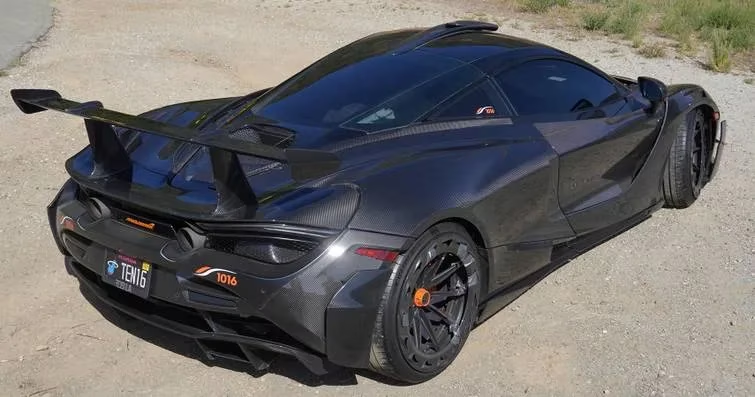
Northrop repeatedly joked about his obsession with details. He pointed out how the carbon fiber weave pattern purposefully transitions over body panel gaps to match, from the roofline down to the wheels. The weave looked like a fossilized lightning storm frozen under clear resin. He described the 2.5-year process of designing, revising, printing, and testing each component of the full 1016 Industries kit on his personal 720S, plus driving over 10,000 miles of daily use during that period. Supercar rallies, city traffic, highway miles—when I checked out the car, plenty of bug guts on the front bumper proved his claim of driving back from Las Vegas only the day before. Luckily, carbon fiber hides flaws and dirt pretty well.
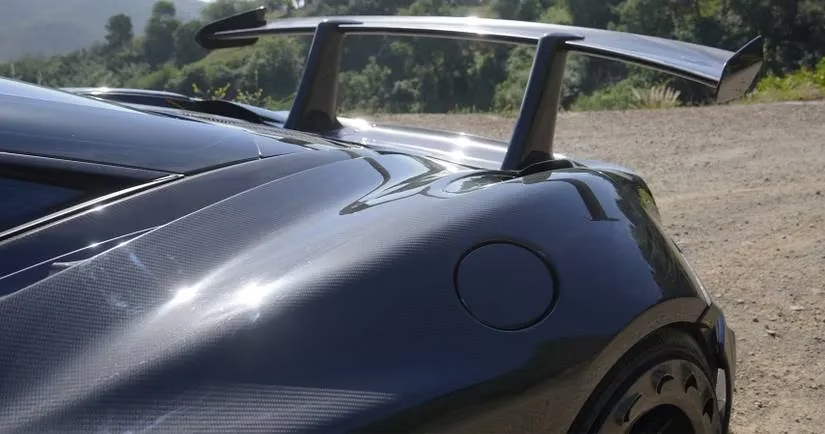
His team first designs every component in CAD, optimizing aerodynamics so he can drive over 200 mph confidently—strictly in the controlled environment of closed tracks, of course—but also to ensure the shape’s lines still flow smoothly from tip to tail despite the new styling. Where even many OEM manufacturers now use faux air inlets and intakes for style points alone, 1016 Industries funnels cooling air from the front all the way into the engine bay. They even render light reflection by computer to make sure the car looks as good as it runs. That massive fixed rear wing, in place of the factory adjustable piece, uses modern organically formed 3D-printed titanium mounts. Northrop admitted the difficulty required to convince the McLaren’s ECU to stop throwing codes about the electrically controlled rear wing delete.
What It Is Like To Drive
Climbing into the cockpit for my first McLaren drive, I wondered how hardcore a worked-over 720S might feel on public roads. Amazingly, Northrop’s engine tuning creates a relatively tame throttle response with enough modulation for average cruising, until I mashed the pedal a couple of times just to experience the performance on tap. The throttle was a velvet sledgehammer: gentle enough for traffic, then geological when I buried it.
Even with so much weight trimmed off the body panels, this 720S retains a balanced suspension that somehow feels solid, not harsh and firm on rougher roads like Piuma and Stunt. It stays planted on the wide tires and begs for confident cornering. A small steering wheel transmits immaculate feedback to the driver. The steering felt like a dowser’s rod, tracing hidden veins in the asphalt. The gearbox apparently knew when I wanted to brake before I did, timing downshifts perfectly with a satisfying throttle blip. If anything, the car felt nearest to a Lotus Evora GT I drove on the same roads a few months earlier—just more, in every way. Maybe combining that Lotus with a Ligier F4 car, plus a bit more comfort than both, more accurately fits the bill.
Pros And Cons
-
✅ Carbon fiber everywhere
-
✅ Tuned engine dyno’d at 986 wheel horsepower
-
✅ Suspension revisions maintain drive quality
-
✅ Aerodynamically optimized for 200+ mph
-
❌ If you have to ask, you cannot afford it
-
❌ Classic McLaren electrical gremlins
-
❌ Some tire rub while cornering on rough roads
Northrop recently moved to Los Angeles after years in Miami and Detroit, a decision that only helped boost the popularity of his body kits. He described the Lamborghini Urus as his biggest seller, though 1016 Industries also offers kits for all kinds of Ferraris, Porsches, and Audis. Forged carbon, as opposed to the more traditional weave, looks great on front trunk hoods, fender flares, mirror caps, and more.
The 720S I drove, however, seems the most attractive to me. While a bit more aggressive than a normal 720S, the design still retains Frank Stephenson’s aquatic biomimicry form—and McLaren’s racing pedigree always sounded almost too good to be true. Without a doubt, a 2,800-pound supercar with up to 986 ponies immediately proves itself as too much car for public roads. But nobody buys a 720S and then adds the full 1016 Industries catalog to prove their sanity. Northrop will fully admit just how much he overbuilt the car to handle far more than average daily driving throws at it.
Once upon a time, when I rode in my first Porsche 911, the owner predicted I would own one someday. But now that I can list a fully carbon-fiber widebody 720S on my record as an initial taste of the McLaren experience, whether a stock supercar—much less a Porsche 911—might possibly be able to scratch this new itch seems like a very serious concern for the future of my automotive life. In 2026, as McLaren pushes deeper into hybrid power and the W1 era, this 1016 Industries 720S feels like a handcrafted rebellion against sameness. It is excessive, expensive, and a little bit unreasonable. That is exactly why I cannot stop thinking about it.