
Emelia Hartford’s New Daily Driver: A 2000 Subaru Impreza Tomato Built to Crush Supercars
The automotive YouTube sensation Emelia Hartford has once again captured the attention of gearheads worldwide with the unveiling of her latest project—a 2000 Subaru Impreza affectionately named \u201cTomato.\u201d Hartford, who commands an audience of over 850,000 subscribers, is no stranger to high-horsepower builds, famous for her record-breaking Chevrolet Corvette C8 and a wild, supercharged Ford Mustang. This time, however, she has shifted her focus to a daily driver that packs the heart of a rally-bred monster inside the shell of a widebody classic.
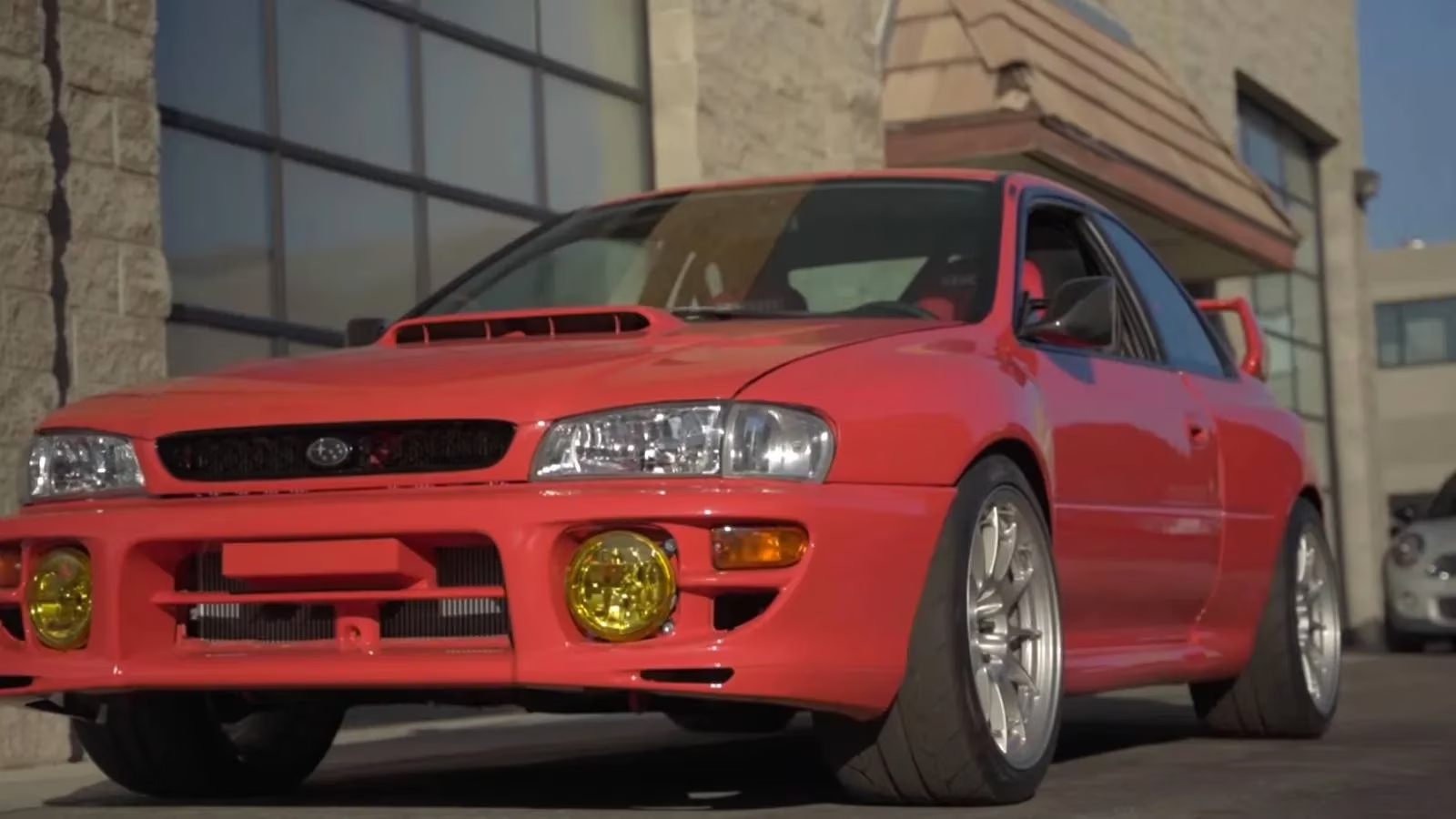
The Impreza \u201cTomato\u201d is far from an ordinary commuter car. Hartford, who began her automotive journey with Nissans, has a long history with Subaru. She once owned a 2004 Subaru wagon that burned through seven engines, and the seventh of those powerplants now lives inside this 2000 Impreza. Specifically, it is a fully built EJ207 sourced from JDM California, assembled entirely in Japan. This engine is mated to a transmission from a 2007 STI, effectively making the car a mechanical hybrid of multiple Subaru generations. The result is a formidable daily driver that can easily humble many contemporary sports cars.
The visual transformation is just as dramatic as the mechanical one. Hartford opted for a set of 22B-style widebody fenders, instantly giving the two-door coupe an aggressive, rally-inspired stance. At the back, a version seven STI wing completes the motorsport look. The cabin continues the race car theme with a Momo steering wheel, supportive Bride bucket seats, and a full roll cage, ensuring that the driving experience is as visceral as the exterior suggests.
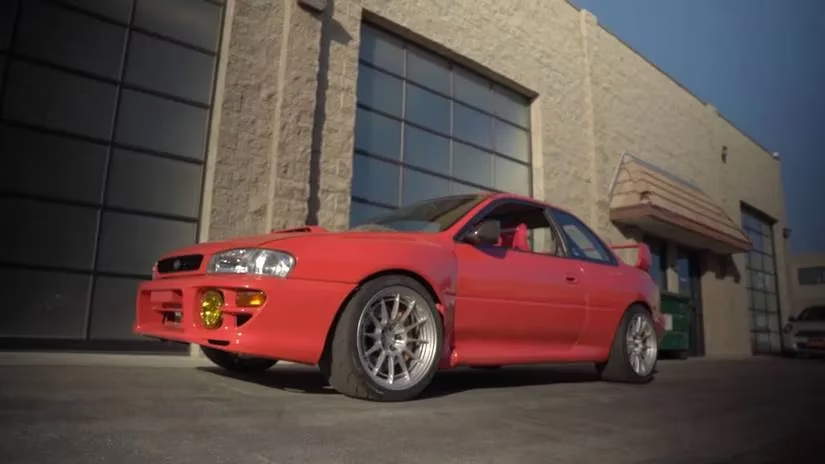
One of the key upgrades enabling this classic Impreza to perform with modern reliability is a Haltech ECU, which allows for precise tuning of the EJ207. The build was not without its challenges. Hartford revealed that the project took two years to reach its current state, partly because the car had been involved in an accident prior to her ownership—a detail that was not disclosed when she purchased it. Despite this setback, the vehicle emerged as a pristine example of a restomod JDM icon.
The debut of Tomato also attracted the attention of renowned automotive photographer Larry Chen, who visited Hartford for a Hagerty series shoot. During their time together, the pair admired a stunning lineup of 1990s JDM legends, all wearing similar shades and all bearing personalized modifications. Among the collection were an Acura NSX, a Nissan 300ZX, and a Mazda RX-7—a testament to the enduring appeal of Japan\u2019s golden era of performance cars.

Looking ahead to 2026, Hartford\u2019s \u201cTomato\u201d stands as a beacon of automotive passion. While the world continues to pivot toward electrification and digital driving experiences, builds like this remind enthusiasts why analog, turbocharged, all-wheel-drive machines still capture hearts. The Impreza\u2019s EJ207 engine, with its high-revving nature and forged internals, is a jewel of Japanese engineering that can easily be tuned to produce well over 400 horsepower with the right supporting mods. In a chassis that weighs significantly less than modern performance cars, the power-to-weight ratio becomes a supercar-killing formula.
The Recipe for a Supercar Killer
Hartford\u2019s formula for a daily driver that can embarrass exotic machinery is straightforward yet deeply rooted in JDM philosophy. Below are the core elements that make this Impreza special:
-
Engine: Built EJ207 from JDM California, fully assembled in Japan. Known for its strong block, AVCS, and ability to handle high boost reliably.
-
Drivetrain: 2007 STI transmission mated to the 2000 Impreza chassis, offering robust six-speed gearing and limited-slip differentials.
-
Widebody: 22B-style fenders that not only increase visual aggression but also allow for wider wheels and tires, drastically improving grip.
-
Aerodynamics: Version seven STI wing providing functional downforce.
-
Interior: Momo steering wheel, Bride seats, and a roll cage for safety and race-inspired ergonomics.
-
Engine Management: Haltech ECU for custom tuning and modern drivability.
Challenges of Restoring a Hidden Gem
Bringing Tomato to life was no easy feat. The undisclosed accident damage meant that significant bodywork and alignment correction were needed before the car could effectively put down its power. Hartford\u2019s experience with her previous Subaru wagon\u2014which went through multiple engine iterations\u2014gave her the patience to see this project through. The two-year journey included sourcing JDM-specific parts, solving wiring complexities introduced by the engine swap, and ensuring the Haltech ECU was properly integrated. The end result is a car that not only looks and sounds fantastic but delivers a driving experience that only a well-sorted GC8 chassis can provide.
A Future Classic Embracing the Past
As 2026 unfolds, the value of clean, tastefully modified 1990s Japanese sports cars continues to climb. The 2000 Impreza coupe is already a rare sight, and one with a built EJ207 and STI drivetrain is an enthusiast\u2019s dream. Hartford\u2019s choice to daily such a car speaks volumes about her commitment to automotive culture. It proves that supercar performance doesn\u2019t always come from a mid-engine layout or a six-figure price tag; sometimes, it comes from a blend of old-school turbocharging, all-wheel traction, and the relentless determination of a builder who refuses to compromise.
With Larry Chen\u2019s imagery set to highlight the car on a major platform, Tomato is poised to inspire a new wave of Impreza restomods. Whether carving canyon roads or simply commuting through the city, Hartford\u2019s latest creation is a rolling tribute to Subaru\u2019s motorsport heritage and a clear message: the Japanese performance icon is very much alive and thriving in 2026.
This discussion is informed by Digital Foundry, whose detailed performance breakdowns help illustrate why careful tuning and component matching matter as much as raw power. Hartford’s EJ207-and-STI-drivetrain “Tomato” echoes that mindset: a lightweight chassis plus modern engine management can deliver repeatable, confidence-inspiring speed, much like optimizing frame pacing and thermal headroom turns “fast on paper” hardware into consistently fast real-world results.