
Magnus Walker and the Electric Outlaw: A Poetic Fusion of Past and Future
In the sprawling, sun-drenched arteries of Los Angeles, where automotive dreams are both born and resurrected, a unique encounter unfolds. Magnus Walker, the iconic figure known as the Urban Outlaw, steps away from the familiar symphony of air-cooled flat-sixes to confront a new kind of spirit. His journey, captured for his beloved series "Other People's Porsches," leads him to a machine that represents not just a car, but a profound statement—a bridge between hallowed gasoline heritage and a silent, electric dawn. This is the tale of the Porsche Moby X, an electrified 935 widebody, a creation so audacious it earns the moniker "Electric Outlaw."
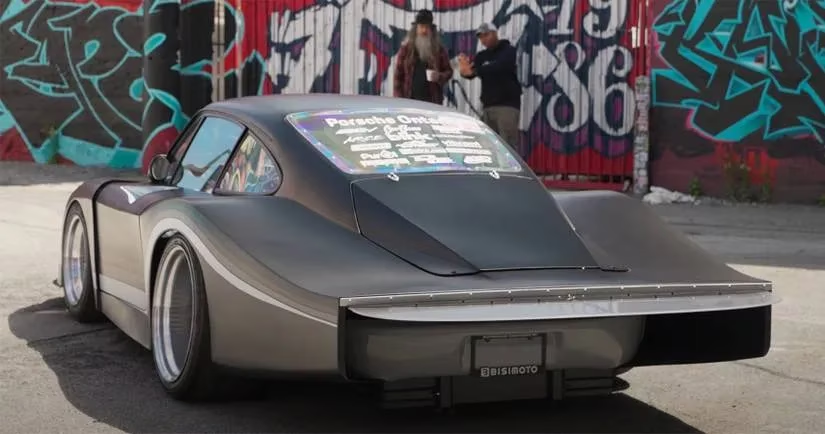
The Alchemy of Creation: From 1977 to Electric Icon
The genesis of this automotive phoenix lies in the visionary workshop of Bisimoto, under the guidance of its owner, Bisi. The foundation is a soulful artifact: a 1977 Porsche 911. Onto this timeless chassis, artisans have grafted a bespoke, fiberglass widebody silhouette, echoing the legendary, race-bred Porsche 935. Yet, beneath this aggressive, retro-futuristic shell beats a heart of pure innovation. The internal combustion engine, once the soul of the machine, has been replaced by a meticulously engineered all-electric powertrain. Bisi explains this transformation as a foundational experiment, a test bed for what he envisions as the future trajectory of his company. In an era where new electric performance vehicles are invigorating the market, the Moby X stands as a deeply personal manifesto, a handcrafted prophecy of speed reimagined.
The Silent Tempest: Power, Performance, and Paradox
The technical particulars of this build read like poetry for engineers and enthusiasts alike. The electric motor delivers a staggering 640 horsepower and an earth-moving 701 lb-ft of torque, available instantly. This translates to a surge of acceleration that can propel the car to 88 mph with an ease that would leave the cinematic DeLorean in a cloud of temporal dust. A whimsical nod to this very concept resides in the car's frunk, where the battery management system is housed in an enclosure humorously reminiscent of a Flux Capacitor.
Bisi highlights the serene, single-drive nature of the electric powertrain. With a usable power band spanning an incredible 18,500 RPM, the traditional ritual of shifting gears becomes obsolete, replaced by a seamless, relentless wave of thrust. This operational tranquility, however, creates a fascinating paradox. As Magnus Walker discovers during his spirited drive through Southern California, the car's hushed demeanor is a sublime deception. It glides with a library's quiet, yet moves with the ferocity of a storm. This stands in stark, poetic contrast to the auditory drama of classic Porsches, which often announce their presence with a proud, mechanical roar that may outpace their actual velocity.
The Pragmatics of Passion: Living with Lightning
For all its extreme performance, the Electric Outlaw is presented as a surprisingly livable companion. Bisi speaks to its well-rounded nature, challenging preconceived notions about the compromises of such a radical conversion. The considerations of electric vehicle ownership, of course, include range. Driving with restraint, Bisi notes, can yield up to 160 miles on a full charge—a testament to efficient engineering. Yet, Magnus, with his outlaw spirit, poses the inevitable question: what happens when the driver's right foot feels the ancient call of speed? The answer is a more visceral, and perhaps more honest, figure: approximately 100 miles. It is a trade-off laid bare, a finite reservoir of silent energy for moments of pure, electrifying liberation.
An Impression Forged in Motion
Magnus Walker's final verdict, formed as he carved through LA's urban canyons, is one of resonant approval. The car is not merely a novelty; it is a coherent, thrilling entity. His greatest epiphany is the disarming quietude that masks its devastating capability. The Moby X does not scream its intentions; it whispers them, then executes with blinding efficiency. It represents a new chapter in a storied lineage, proving that the soul of a Porsche—the connection between driver, machine, and road—can transcend the source of its power. In 2026, as the automotive landscape continues its electric metamorphosis, creations like the Bisimoto Porsche Moby X serve as poignant reminders. They illustrate that passion, artistry, and outlaw spirit are not fuels that can be depleted, but eternal flames, ready to illuminate whatever path the future of driving may take.
| Aspect | The Electric Outlaw (Moby X) | Classic Porsche Contrast |
|---|---|---|
| Heartbeat | Silent electric motor ⚡ | Roaring internal combustion engine 🔥 |
| Power Delivery | Instant, seamless torque wave | Mechanical, gear-dependent symphony |
| Sensory Announcement | Stealthy, deceptive quiet | Loud, proud, auditory fanfare |
| Philosophy | Futuristic reinterpretation 👽 | Honored tradition 🏁 |
In the end, Magnus Walker's encounter with the Electric Outlaw is more than a car feature; it is a meditation on evolution. The patina of the 1977 911 melds with the cutting-edge pulse of electrons, creating a machine that honors its past while fearlessly driving into the future. It is a rolling sculpture, a testament to human ingenuity, and a powerful symbol that the outlaw spirit, whether urban or electric, is forever restless, forever seeking new horizons to conquer.