
Only 341 Were Built: Why The 1970 Mercury Cyclone Spoiler 429 Still Rules
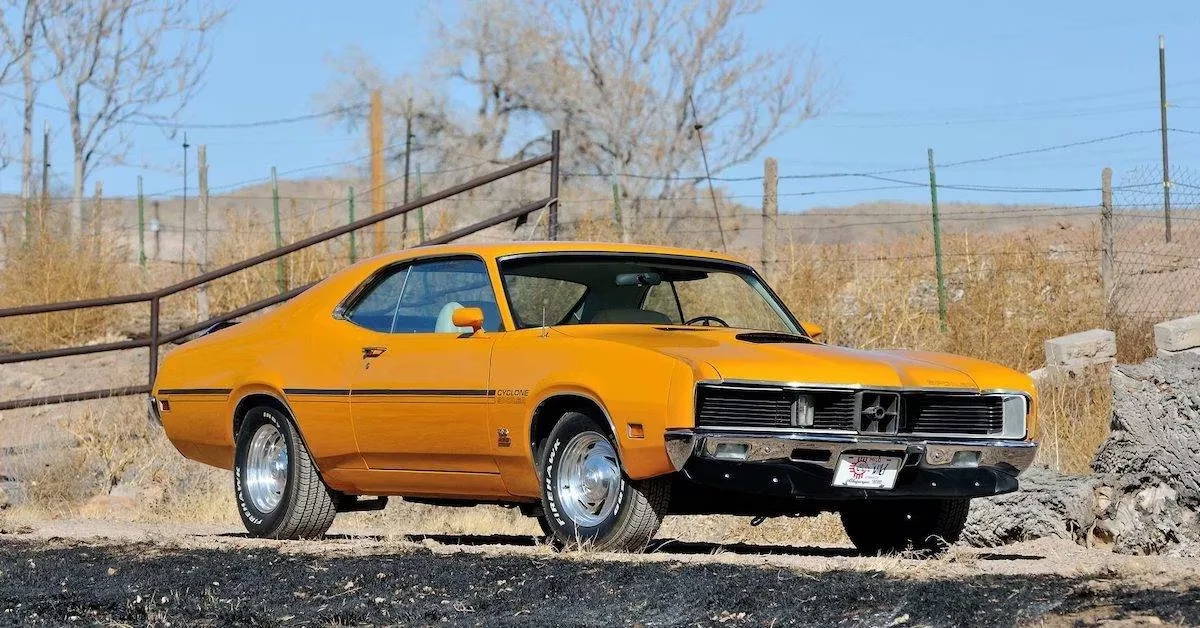
In the pantheon of early 1970s American muscle, Ford's own Mustangs and Torinos usually grab the headlines. But any gearhead with a soft spot for underdogs knows the Mercury Cyclone Spoiler 429 was the quiet assassin in the Blue Oval's lineup. It didn't have the celebrity swagger of a Hemi 'Cuda or the household-name status of a Chevelle SS 454, but on paper—and on the street—it could run with the best of them. Only 341 of these 1970 Spoilers are believed to have left the factory, which makes spotting one today a bit like finding a four-leaf clover in a junkyard.
🏁 A Short But Wild Run
The Cyclone story didn't begin as a standalone muscle car. In 1964, Mercury introduced the Comet Cyclone as the performance trim level of the Comet, taking over from the S-22. It was a beefed-up package, but it still lived in the Comet's shadow. Things changed in 1968 when the Cyclone moved to the mid-size platform shared with the Ford Torino and became its own animal. From that point forward, it was marketed as the Mercury Cyclone, a proper nameplate aimed at buyers who wanted Blue Oval muscle with a Mercury badge.
The Cyclone lasted four generations before bowing out after 1971:
-
🚗 First generation: 1964–1965
-
🚗 Second generation: 1966–1967
-
🚗 Third generation: 1968–1969
-
🚗 Fourth generation: 1970–1971
In Mercury's hierarchy, the Cyclone sat above the Cougar and below the Marquis and Marauder. But for the serious performance crowd, the Cyclone Spoiler was introduced for 1969. There was even a Spoiler II variant that went NASCAR racing. By 1970, the Spoiler returned in very limited numbers, and the 429 Cobra Jet version became one of the great under-the-radar bruisers of the era.
🔥 Big-Block Performance That Hits Hard
The star of the show is the 429 cubic-inch Cobra Jet V8. It pumps out 375 horsepower at 5,200 rpm and 450 lb-ft of torque at 3,400 rpm. For a car that tips the scales at 3,918 pounds, that is plenty of grunt. The weight-to-power ratio works out to 10.4 pounds per horsepower, which was nothing to sneeze at in 1970.
| Spec | 1970 Mercury Cyclone Spoiler 429 |
|---|---|
| Engine | 429 c.i. Cobra Jet V8 |
| Horsepower | 375 hp @ 5,200 rpm |
| Torque | 450 lb-ft @ 3,400 rpm |
| 0–60 mph | 6.0 seconds |
| Theoretical top speed | 125 mph |
| Curb weight | 3,918 lbs |
| Weight-to-power | 10.4 lbs/hp |
The Cyclone Spoiler 429 was a straight-line bruiser. A 0–60 mph time of six seconds was respectable for a big mid-size coupe of the period, and the theoretical 125 mph top speed meant it had legs on the highway. It wasn't a scalpel in the corners, but it didn't need to be. This was a muscle car built for stoplight battles and long open roads.
⛽ Driving Character And Fuel Realities
As expected from a muscle car of this era, the 1970 Cyclone Spoiler 429 sends power to the rear wheels. A four-speed manual transmission came standard, while an automatic was optional for those who wanted to keep one hand free. Front disc brakes and rear drum brakes were the stoppers, and power steering was available as an option—a worthwhile box to tick if one wanted to wrestle less in parking lots.
Fuel economy, unsurprisingly, was not the Cyclone's strong suit. In the city, it returned between 7.3 and 8.7 miles per gallon. On the highway, the numbers improved slightly to between 9.2 and 11 mpg. The combined average was about 9.9 mpg, and with a 20.1-gallon fuel tank, the average range was roughly 199 miles. In other words, a drive to the next car show could require a fuel stop. Modern hybrid owners would probably faint.
🎨 Looks That Mean Business
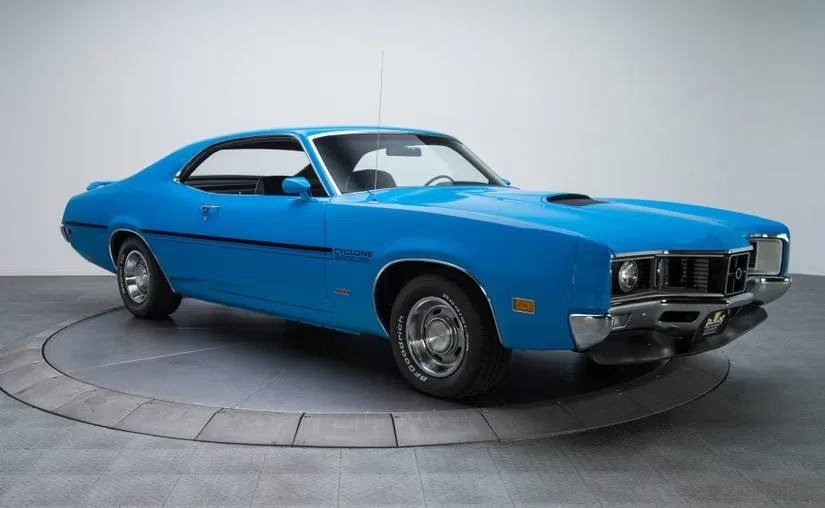
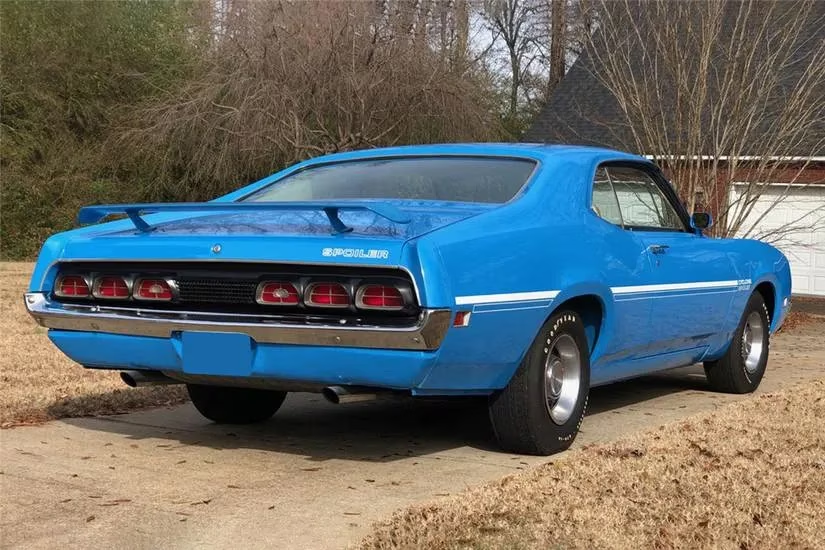
The Spoiler package gave the Cyclone plenty of visual muscle. Racing stripes in black or white ran over the body, a hood scoop fed extra air to the engine, and front and rear spoilers completed the aggressive stance. Racing-style mirrors added to the track-ready vibe. Buyers could choose from a palette that included Competition Yellow, Competition Blue, Competition Orange, Competition Green, Competition Gold, and Pastel Blue. A handful of cars also left the line in non-standard colors thanks to Ford's 'color of your dreams' policy.
The most striking exterior detail was the redesigned front grille. The center of the blacked-out radiator grille jutted forward like the prow of a ship, giving the car a menacing, sleek face. Hidden headlights were optional, and the front fenders stretched forward to complete the look. It hit all the right notes for a hard-rocking muscle car.
🪑 Cabin Vibes
Inside, the Cyclone Spoiler kept things simple and focused. Vinyl bucket seats were standard, and the dash featured a four-gauge display that included a 140 mph speedometer and an 8,000 rpm tachometer with an adjustable red line. Air conditioning was not available, so the cabin could get toasty during summer cruises. Overall, the interior had a Spartan but comfortable racing feel. The optional center console added a bit of decor with fake wood trim, but nobody bought this car for luxury.
💎 Rarity In 2026
More than five decades later, the 1970 Mercury Cyclone Spoiler 429 remains a needle in the haystack. With only 341 believed to have been made, it is far rarer than many of the era's more famous muscle cars. That rarity keeps collector interest simmering in 2026, especially for examples that still wear their original Competition colors and factory spoilers. It may not have the pop-culture fame of a Hemi 'Cuda, but the Cyclone Spoiler 429 has earned its place as one of the great sleeper muscle cars of the 1970s.