
The GMA T.33 Spider: A Timeless V12 Masterpiece Defying Engineering Norms
Let me tell you, as a car enthusiast living in 2026, I thought I'd seen it all. Electric hypercars with ludicrous mode, autonomous pods that look like toasters on wheels—you name it. But then, Gordon Murray Automotive goes and drops the T.33 Spider, and suddenly, the world makes sense again. It's like they took a time machine, grabbed the soul of a classic Formula 1 car, wrapped it in timeless beauty, and said, 'Here, have some proper engineering.' When the T.50 proved the naysayers wrong, I shouldn't have been surprised that their next act would be this breathtaking open-top symphony. The T.33 Spider isn't just another supercar; it's a declaration that passion, purity, and genius still have a place on our roads.
A Design That Stares Down Father Time 👴➡️✨
Gordon Murray had one non-negotiable goal for the T.33 Spider: timelessness. Not just 'looks good for a few years,' but a design that will be admired decades from now. In an era of aggressive vents and overwrought styling, the T.33 Spider is a lesson in elegant simplicity. Its lines are clean, purposeful, and utterly beautiful. But achieving this 'timeless' look while making it work like a race car? That's where the magic happens.
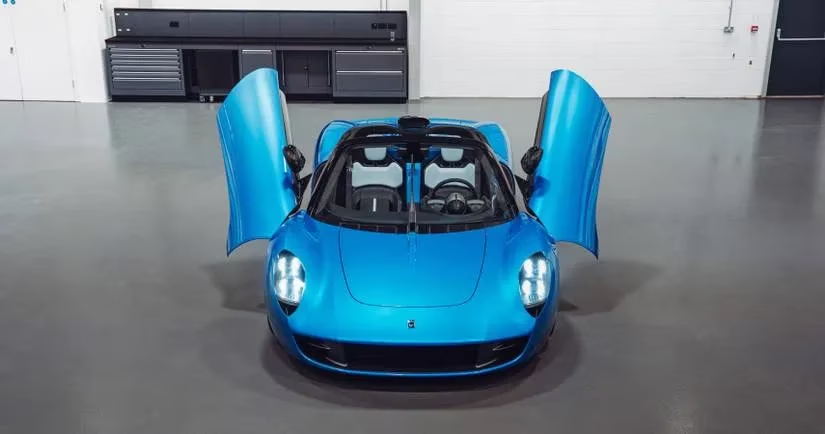
The aerodynamics team faced a Herculean task. They had to create massive downforce without slapping on the usual array of garish splitters, ducts, and skirts that clutter modern supercars. And folks, they absolutely nailed it.
Secret Aerodynamic Sauce: No Moving Parts Required 🍃
The T.33 Spider employs what GMA calls a 'Passive Boundary Layer Control' system. Sounds complex, right? Let me break it down. Imagine the air flowing under the car getting lazy and slow (that's the 'boundary layer'). This system cleverly sucks that sluggish air away through a duct, keeping the airflow underneath nice and fast. This creates serious ground effect downforce—the kind that glues race cars to the track—without any active, power-sapping gizmos. For extra grip when you're really pushing it, a subtle active rear spoiler pops up. The result? A car that slices through the air with minimal drag but generates downforce like a beast. It's pure, intelligent engineering.
The Roof's Off, But the Stiffness Isn't! 💪
Here's the classic convertible dilemma: chop the roof off, and the car turns into a wobbly mess. Handling goes out the window, and the chassis feels about as stiff as a wet noodle. Every other manufacturer accepts this as a necessary evil. Gordon Murray? He saw it as an unacceptable compromise.
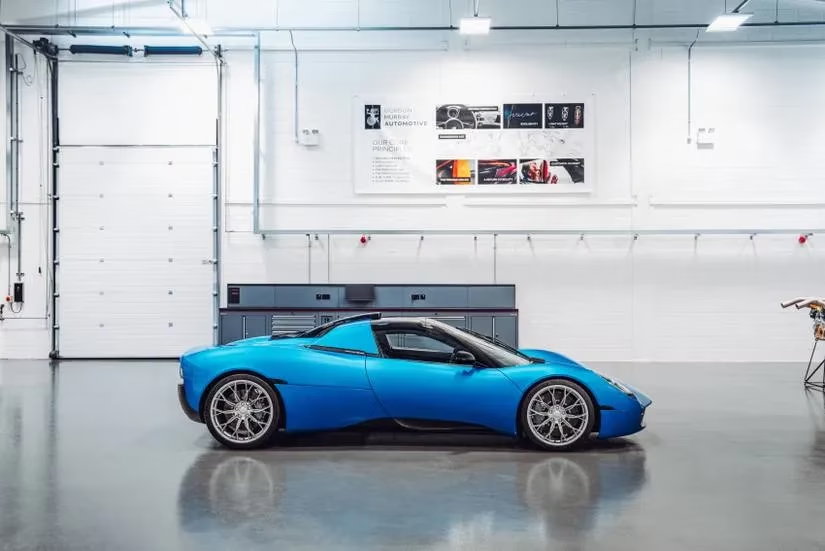
The T.33 Spider is built around GMA's revolutionary 'iStream Ultralight' carbon monocoque. This carbon fiber core is incredibly strong and light. But the real stroke of genius is the fixed rear roof section. This isn't just for a cool 'speedster' look with those iconic twin humps. It acts as a massive structural brace, providing rollover protection and adding crucial rigidity right where the car needs it most in a corner. The benefit? Almost zero body flex and a cabin that stays serene, even with the top down. Buffeting? What buffeting?
The Weight Watchers Miracle 🏆
This is the stat that made my jaw hit the floor. Ready? The target dry weight for the T.33 Spider is 2,442 lbs. Let that sink in. An open-top, V12 supercar weighing about as much as a hot hatch. Even more insane? It's only 39 pounds heavier than the fixed-roof T.33 coupe. In the world of automotive engineering, that's not an achievement; it's a miracle. Adding a folding roof usually adds hundreds of pounds. GMA's obsessive focus on lightweight materials and structural efficiency has completely rewritten the rulebook. This lightness is the secret ingredient to its supernatural agility.
The Heart and Soul: Cosworth's Screaming V12 🎶
All this brilliant chassis work would be for nothing without the right engine. And oh boy, did they pick the right one. Nestled behind the cabin is a Cosworth-built, naturally aspirated 3.9-liter V12. It revs to an ear-splitting, spine-tingling 11,100 RPM. In 2026, where turbochargers and hybrid systems are mandated nearly everywhere, this engine is a rebellious, glorious relic. It produces 607 horsepower and, more importantly, a sound that is pure mechanical poetry—a howl that echoes the golden age of Formula 1. It's connected to one of the lightest production gearboxes ever made and sends power to the rear wheels only. The driving equation is beautifully simple:
-
Engine: High-revving NA V12
-
Gearbox: Manual (Hallelujah!)
-
Drivetrain: Rear-wheel drive
-
Result: Unfiltered, analog driving joy.
Why This Car Matters in 2026 🌍
In our current landscape of tightening emissions regulations and the relentless march toward electrification, the T.33 Spider feels like a magnificent last stand. It's a car built not for compliance, but for the sheer love of driving. It proves that when engineers are unleashed from the constraints of mass-market compromises and allowed to pursue perfection, they can create something transcendent.
| Aspect | T.33 Spider Achievement | Why It's Brilliant |
|---|---|---|
| Weight | 2,442 lbs (dry) | Lighter than most convertibles by a country mile |
| Aero | Passive Boundary Layer Control | Race car downforce without ugly add-ons |
| Chassis Stiffness | iStream Carbon + Fixed Roof | Convertible agility that rivals a coupe |
| Engine | 11,100 RPM Cosworth V12 | An auditory masterpiece in a silent world |
| Philosophy | Pure, analog driving | A defiant celebration of the driver's art |
For the 100 lucky customers who get to own one, the T.33 Spider won't just be a car; it will be an experience. The feeling of that high-revving V12 singing behind you, the precise click of the manual gearbox, the wind in your hair without a hint of chassis shake—it's a combination we may never see again. The Gordon Murray Automotive Group hasn't just built a supercar; they've built a monument to a fading era, crafted with such intelligence and passion that it might just inspire the next one. And for that, I tip my hat. 🎩