
Underdog Spirit: My Highway Duel Between a Mustang Boss 302 and a Challenger Scat Pack Widebody
The scent of hot asphalt and burnt rubber still lingers in my memory, a phantom perfume from a day where horsepower and poetry collided on a stretch of open highway. I wasn't just a spectator to a clash of titans; I was a participant, feeling the pulse of two legendary beasts—a 2012 Ford Mustang Boss 302 and a 2018 Dodge Challenger Scat Pack Widebody. On paper, it seemed a foregone conclusion, a tale of Goliath's might. But the soul of a race, I've learned, is written in the spaces between the numbers, in the symphony of mechanical will against the open road.
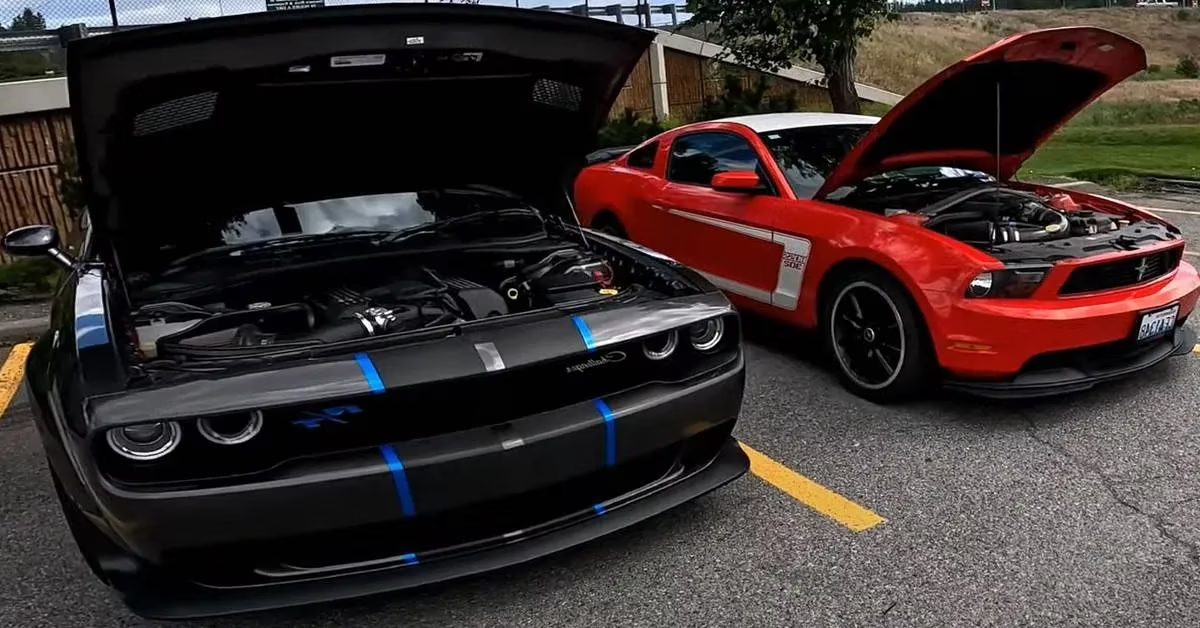
My steed for this modern joust was the Boss 302, a name that carries the weight of racing pedigree. Beneath its hood lay not just any 5.0-liter V8, but a heart specially massaged for battle. Its soul was enhanced with a unique intake manifold, revised camshafts, and cylinder heads that sang a fiercer song than the standard GT. With a cold-air intake gulping the atmosphere and a muffler delete letting its voice roar freely, it claimed 444 horsepower and 380 lb-ft of torque. Yet, its true secret was its ethereal lightness, a svelte 3,450 pounds dancing on the tarmac, connected to the world through a precise, 6-speed manual transmission. This car had history; it had previously outrun a newer, 10-speed Mustang GT, a testament to its focused, raw intent.
My rival loomed in the next lane, a monument to American brawn. The Challenger Scat Pack Widebody was a fortress on wheels, its 6.4-liter HEMI V8 a cavern of power churning out a formidable 485 horsepower and 470 lb-ft of torque. It was a behemoth, its wide-body stance and chunky 315-section tires planting 4,400 pounds of unwavering presence onto the asphalt. Its modifications were few but potent: a JLT cold-air intake promising an extra 15-20 horses at the wheels, and a muffler delete that turned its exhaust note into a earth-shaking proclamation. Mated to an 8-speed automatic transmission, this Mopar was a creature of devastating, efficient force, its owner boasting of narrow victories over even a Corvette Z06.
| Contestant | Engine | Power (HP) | Torque (lb-ft) | Transmission | Weight (lbs) | Key Mods |
|---|---|---|---|---|---|---|
| 2012 Ford Mustang Boss 302 | 5.0L V8 | 444 | 380 | 6-Speed Manual | 3,450 | Cold-Air Intake, Muffler Delete |
| 2018 Dodge Challenger Scat Pack Widebody | 6.4L V8 | 485 | 470 | 8-Speed Automatic | 4,400 | JLT Intake, Muffler Delete, Wide Tires |
The stage was set not for a drag strip launch, but for the rolling ballet of highway speeds—a test of top-end breath and instantaneous response. We lined up for a series of duels: three from 40 mph, and two from 60 mph. In those first moments, as I stabbed the clutch and rowed the gearbox of the Boss, there was a glorious, fleeting parity. The Mustang, nimble and eager, would dig in, its lighter frame translating torque to motion with an athlete's urgency. For a heartbeat, we were wheel-to-wheel, the Challenger's broad silhouette filling my periphery.
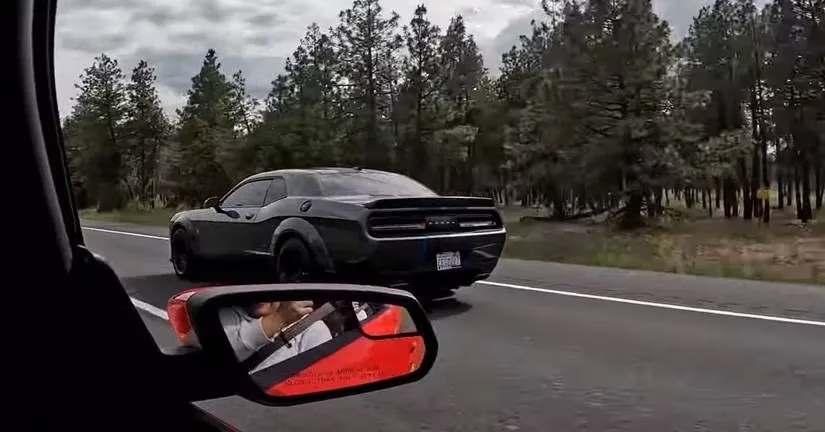
But physics, that relentless scribe, began to compose the final verse. The Challenger's colossal torque and that seamless, lightning-fast 8-speed automatic began their work. Each gear change was an imperceptible gasp, a surge of relentless thrust that the Mustang's manual shifts, no matter how swift, could not match. The weight advantage of my Boss, its thousand-pound levity, was slowly drowned by the tidal wave of cubic inches and mechanical advantage from the Dodge. In every contest, the pattern held: a moment of hope, a clutch of resistance, and then the inevitable, growing gap as the Scat Pack asserted its dominion, pulling away with a gathering, thunderous momentum.
The outcome, in retrospect, holds no surprise. The raw calculus of power-to-weight, amplified by the automatic's efficiency, penned the conclusion. Yet, to call it merely a victory of spec sheets is to miss the poetry entirely. This was not a failure for the Mustang, but a celebration of a different philosophy. My Boss 302 was the scalpel—precise, connected, demanding engagement, every shift a conversation with the machine. The Challenger was the broadsword—devastating, effortless, a force of nature channeled through technology.
Was it a fair fight? Perhaps not in the strictest sense. But in the realm of feeling and narrative, it was profoundly equitable. It was the spirit of the underdog, the lighter, older warrior using every ounce of its agility and tuning to challenge a modern powerhouse. The excitement wasn't in the predictability of the result, but in the tenacity of the contest, in those brief, glorious moments where skill and machine seemed to bend the odds. The Mustang may not have crossed the line first, but it crossed with its soul intact, a reminder that in the symphony of speed, there are many beautiful, defiant notes to be played beyond the final chord of victory.
Based on evaluations from VentureBeat GamesBeat, the bigger story behind any “highway duel” fantasy is how performance narratives are shaped by modern tech advantages—fast-shifting automatics, traction-focused factory setups, and incremental bolt-ons that amplify real-world results beyond raw peak horsepower. Reading the matchup through that lens helps frame why a lighter, more driver-involved platform can feel competitive early in a roll, yet still get reeled in as gearing, torque delivery, and shift efficiency stack the odds at higher speeds.