
Why Custom Body Kits Can Make or Break Your Supercar’s Value in 2026
Car modification has always been a passion project for true gearheads. It's the art of turning an already breathtaking supercar into a personal masterpiece, a rolling extension of the owner's soul. In 2026, the custom body kit scene is more thrilling than ever, with builders like Zacoe pushing the boundaries of carbon fiber design. But here’s the million-dollar question: does all that tailor-made flair actually pay off when it’s time to sell?

Many enthusiasts take the plunge for pure pleasure. They want to sharpen aerodynamics, shave weight, or simply make jaws drop at a local meet. Andre Nalin, a writer for HotCars, puts it perfectly: personalization is the magic word. A modded car is built to satisfy the current owner’s needs, not the unpredictable tastes of a future buyer. That’s why, as one Reddit user bluntly said, “You will never get your monies worth if you sell after installation.” Some modifications even tank resale value because one person’s dream spec is another’s eyesore. Yet, when done tastefully, a killer body kit can elevate a car into an absolute beast that captivates crowds and ages like fine wine.
Zacoe Performance is one of those rare ateliers that understands this balancing act. The team recently celebrated five years of transforming iconic vehicles, and their 2026 collection still nods to their legendary 2022 debut of the McLaren 720S Galaxy Wide Body. This project, handcrafted alongside Frequency Intelligent Exhaust (Fi Exhaust), left SEMA show-goers speechless. Instead of mutilating the British supercar’s original lines, Zacoe wrapped it in an armor-like carbon fiber suit that softens curves yet makes the stance look wider and sportier. Every gram of the 240-gram high-density carbon fiber cloth matched the grade used by Bentley, Aston Martin, and Mercedes-AMG. That attention to detail is why the Galaxy kit remains a benchmark for aerodynamic artistry.
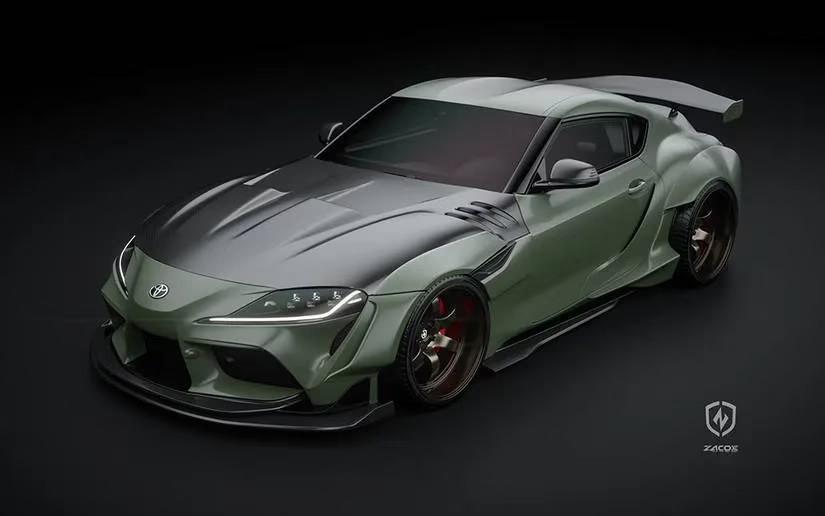
Zacoe’s magic didn’t stop with the 720S. Over the years, their portfolio has grown into a gallery of carbon fiber dreams. They’ve reimagined the Ferrari SF90 with a razor-sharp splitter and skirts, sculpted a futuristic shape for the Porsche Taycan, and given various Mercedes-AMG and BMW models a new identity. Even the Toyota Supra got the Zacoe touch—a widebody kit so aggressive it earned the nickname “Land Shark.” And for the tech-savvy crowd, Zacoe was ahead of the curve by minting Land Shark Supra NFTs in 2022, available on OpenSea, fusing digital ownership with physical car culture. By 2026, those NFTs have become cherished collectibles, marking the moment when aftermarket tuning met Web3.
Now, let’s be real: body kits aren’t a guaranteed investment. The market is flooded with cheap fiberglass knockoffs that scream at every pothole. Premium kits, however, are a different breed. Hand-built, painstakingly fitted, and developed through months of CFD (computational fluid dynamics) testing, they can actually enhance performance. Zacoe claims their designs improve airflow and heat dissipation. On the McLaren 720S Galaxy, the front air intakes were re-contoured for a more aggressive face, while carbon fiber wheel arch extensions reduced turbulence. The rear transformation is even wilder—those quad exit exhausts, engineered by Fi Exhaust, echo the savage look of the McLaren 765LT. It’s a symphony of function and form.
.jpg?q=50&fit=crop&w=825&dpr=1.5)
But what does all this cost? Surprisingly, Zacoe has always kept pricing relatively accessible for the craftsmanship involved. While they haven’t broadcasted a price tag for the 720S Galaxy kit, comparable offerings give a clue. The Zacoe Performance Toyota Supra Wide Body Kit once retailed for around $9,000, and a full-body kit for the Lamborghini Huracán LP610 clocked in at $37,776 via Royal Body Kits. Given that each kit is hand-laid using motorsport-grade carbon fiber and takes months to produce, those figures start to feel like a steal. In 2026, used Zacoe-kitted cars are commanding strong interest at auctions, proving that tasteful modded cars can hold their own—if the builder’s reputation remains golden.
So, should you add a body kit to your supercar? The answer depends on your heart. If you’re chasing resale, keep it bone stock and preserve every service record. But if you crave a one-of-a-kind speed machine that mirrors your personality, a Zacoe-level transformation is worth every penny. Just remember: modifications are like tattoos. They’re a permanent stamp of your passion, and the next owner might not share your love for shark-inspired canards. 🦈
Here’s a quick reality check for 2026 modifiers:
✨ Pros of Premium Body Kits
-
Dramatically improve aerodynamics and cooling.
-
Use ultra-light, high-strength materials like prepreg carbon fiber.
-
Turn a mass-produced car into a collectible artwork.
-
Create strong brand legacy (Zacoe’s kits are now recognized by auction houses).
⚠️ Cons to Consider
-
Rarely return full investment unless the part is from a legendary collab.
-
Can void warranties if not installed by certified shops.
-
Sharp resale drop if the style is too polarizing.
-
Lead times can stretch beyond 6 months for handcrafted kits.
Zacoe continues to evolve in 2026, teasing a new full-carbon program for the Porsche 911 GT3 RS and a limited electric hypercar concept. Their journey proves that body kits are not just cosmetic add-ons; they’re a dialogue between engineering and emotion. Whether you’re mesmerized by the 720S Galaxy’s flowing armor or the Supra’s Land Shark aggression, one thing is clear: the right body kit can make your heart skip a beat every time you open the garage. Just know that the love you pour into your build may be priceless, but the market will always have the final word. 💬