
The Thunderous Heartbeat of Performance Exhaust Systems: A Gearhead's Ecstasy
As a die-hard gearhead and professional gamer, I've spent countless hours in virtual racetracks and real-world garages, but nothing—absolutely nothing—compares to the spine-tingling, earth-shattering roar of a performance exhaust system. It's not just a sound; it's a primal scream that courses through my veins like liquid adrenaline, transforming a mundane drive into a symphony of raw power. I remember the first time I revved up my custom-tuned beast—the deep, guttural growl felt like the engine was speaking directly to my soul, promising untapped horsepower and a rush that no video game could ever replicate. In 2025, with electric vehicles silently dominating the streets, this mechanical roar is a rebellious anthem, a reminder of the combustion era's glory. But let's dive into the mystical art of exhaust tuning, where science meets sorcery to unlock hidden engine potential.
The Alchemy of Exhaust Design: More Than Just Pipes and Noise
Forget the old myths about "free-flow" exhausts—those are child's play! Modern exhaust systems are intricate masterpieces, meticulously crafted to manipulate high- and low-pressure waves like a puppeteer pulling strings. As I've tinkered in my garage, I've learned that it's not about slapping on loud mufflers; it's about orchestrating a dance of gases that scavenge every last bit of power. For naturally aspirated engines, tuned-length headers with tortuous routing are the secret sauce, while turbo-charged beasts follow their own arcane rules. Picture this: the exhaust pulse racing down the tube at 300 feet per second—it's like a cheetah sprinting across the savannah, leaving a vacuum in its wake. And oh, the thrill when that low-pressure wave sucks out spent gases, making the engine breathe easier! It's pure magic, I tell you.
Here's a quick breakdown of key factors in exhaust tuning, based on my hands-on escapades:
| Factor | Role in Performance | Optimal Range | My Personal Take |
|---|---|---|---|
| Header Tube Diameter | Balances flow vs. scavenging | 1-3/4" to 2-3/8" | Too wide, and it's like blowing air through a canyon—loud but lazy; too narrow, and it chokes like a clogged artery. |
| Primary Tube Length | Tunes wave timing for scavenging | 28-30" for race engines | Get this wrong, and the engine stutters like a bad Wi-Fi connection; nail it, and it purrs like a contented lion. |
| Exhaust Gas Velocity | Key to inertial scavenging | ~300 ft/sec | Hit this sweet spot, and it's smoother than butter on a hot skillet—miss it, and power drops faster than a dropped controller. |
Now, let's talk scavenging mechanisms—the real heroes. Inertial scavenging relies on the gas's momentum, like a freight train barreling down the tracks, unstoppable even after the valve closes. I've felt this in my bones during high-speed runs; it's as if the exhaust is a living entity, pushing forward with relentless force. Then there's wave scavenging, which uses sound waves traveling faster than Mach 1 to create negative pressure. Imagine it as a sonic boom in reverse—when timed perfectly, it sucks gases out like a cosmic vacuum cleaner. This isn't just engineering; it's poetry in motion. 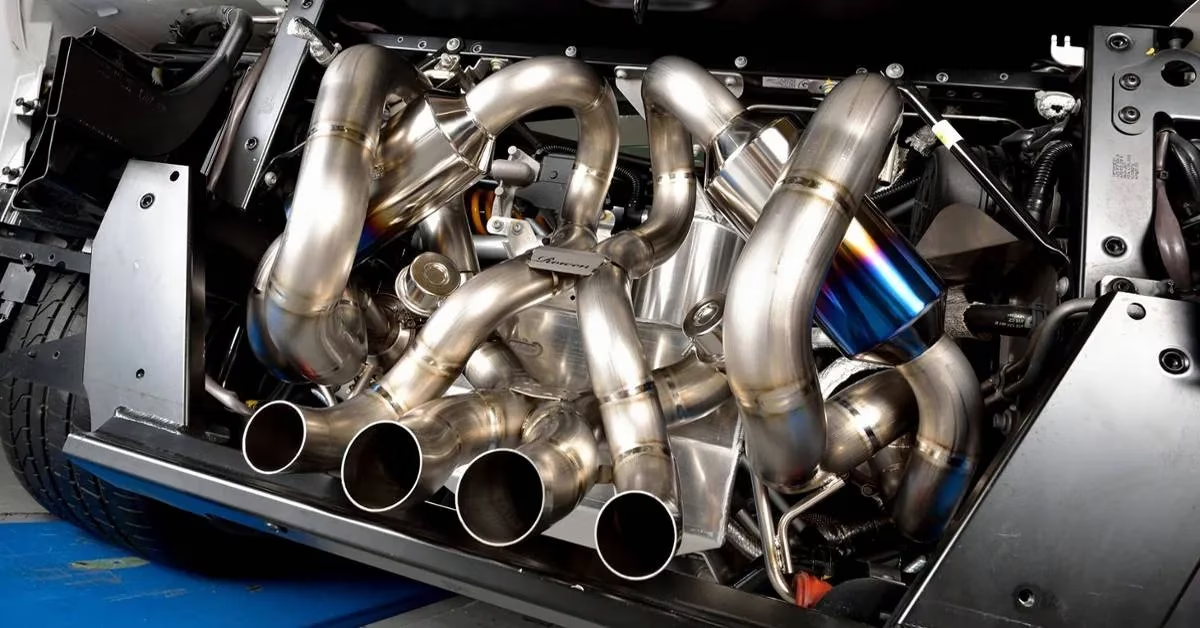 Witness this beauty on a Lambo—pure art that makes my heart race!
Personal Revelations and the Art of Tuning
In my gaming rigs, I simulate exhaust notes with haptic feedback, but nothing beats the real deal. I recall tuning my project car's headers—each adjustment felt like defusing a bomb, where one wrong move could turn power into pitiful whimpers. The relationship between tube diameter and velocity? It's a high-wire act. For smaller engines, 1-7/8-inch tubes are gold, but for big blocks, 2-3/8-inch monsters reign supreme. Hooker Headers taught me that 300 ft/sec is the holy grail; achieve that, and the exhaust pulse flows like a river in flood, sweeping away inefficiencies. And let's not forget wave scavenging—tuning the length to match engine RPM is like composing a concerto where every note must land at the exact millisecond. If it's off, the performance flatlines; get it right, and you gain 2-3% more power—a small number, but in racing, that's the difference between podium glory and obscurity. 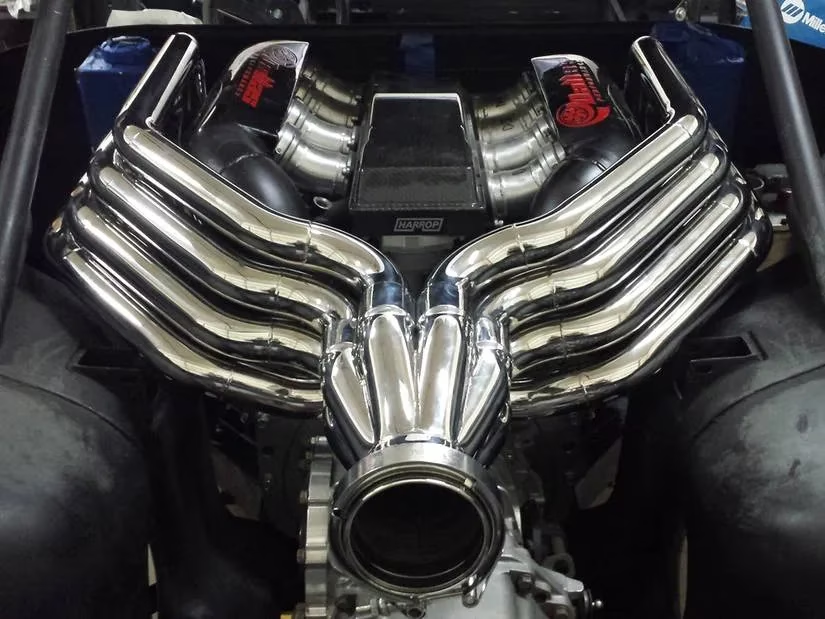 This Pantera setup? It's a beast that roars with the fury of a thousand storms!
But here's where it gets personal: the exhaust system is like the heartbeat of a dragon—each pulse is a fiery breath that ignites my passion. Tuning it is as delicate as calibrating a Stradivarius violin; one millimeter off, and the harmony shatters into discord. And that low-pressure wave? It's a silent assassin, sneaking in to clean the combustion chamber like a ninja wiping away traces of battle. In 2025, with AI-assisted tuning tools, we're pushing boundaries, but the core thrill remains. 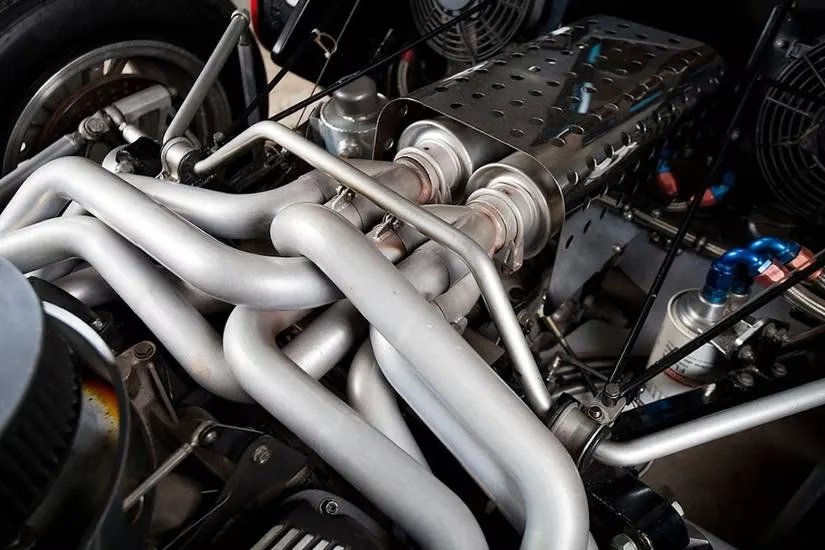 These GT40 headers? Pure vintage power that still makes me weak in the knees.
The Future: An Open-Ended Journey
As we cruise into this electric-dominated era, I can't help but wonder: will the soul-stirring roar of performance exhausts fade into nostalgia, or will innovators blend it with synthetic sounds for hybrid marvels? What if we could harness wave scavenging in silent EVs to boost efficiency? The possibilities are endless, and I'm left pondering—does progress mean silencing our mechanical symphonies, or can we find new ways to keep the thunder alive? 🤔